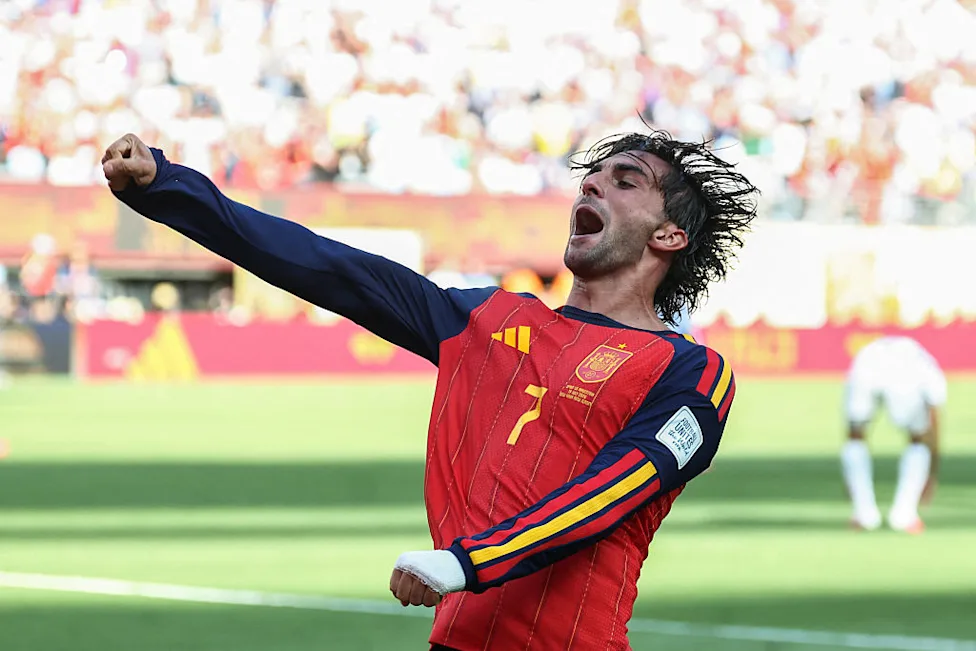
Nobody had this one on a prediction sheet. Not the bookmakers, not the Spanish press, and certainly not the people who spent the group stage arguing that Luis de la Fuente had picked the wrong forward.
The 106th minute at MetLife Stadium on 19 July settled a final that Spain had controlled almost from kickoff without managing to actually win it. Emiliano Martínez had been extraordinary for an hour and a half. Argentina hadn’t registered a shot in the opening ninety minutes, hadn’t touched the ball inside the Spanish box, and were down to ten men after Enzo Fernández picked up a second yellow in the 93rd. Then a Pedro Porro cross reached Nico Williams, whose header kept the move alive, and the ball dropped to a substitute who needed exactly one touch.
Thirty-nine seconds into the second half of extra time. Roof of the net. Spain world champions for the second time, sixteen years after Johannesburg.
The tournament produced 104 matches across three countries and 48 teams, and it generated an enormous amount of traffic for anyone tracking form and squad data through the group phase. Sites like dbbet carried the match-by-match numbers in Russian and Uzbek, which mattered in a region where kickoffs from Atlanta and New Jersey landed somewhere between midnight and four in the morning. The same late-night audience that keeps казино узбекистан онлайн searches climbing every summer spent five weeks on Central Asian time watching football played on the other side of the planet.
Before the final: a genuinely rough month
Here’s the part that gets skipped in the highlight packages. The ferran torres stats sheet from World Cup 2026 reads as follows: eight appearances, one start, 283 minutes, one goal, one assist, average match rating 6.4.
That’s it. Thirty-five minutes per game across an entire tournament, from a player who had arrived with 55 caps and 23 international goals behind him.
The one start came in the opener against Cabo Verde in Atlanta on 15 June, and it went badly. Spain drew 0-0, which nobody had predicted either, and the clearest chance of the afternoon fell to Torres five minutes before the break — a Marc Cucurella header across the six-yard box, an open goal from roughly five yards out, and the ball went off the crossbar. Miss of the tournament, according to a fair chunk of Spanish media that evening.
Lamine Yamal returned for the Saudi Arabia match. The starting place went with him and never came back. Everything from that point onward happened from the bench.
What the bench role actually looked like
Being a squad forward at a 48-team World Cup is a strange job. Seven substitute appearances, mostly short, mostly with instructions to press and stretch a tired defence in the last twenty minutes.
The numbers from that role are modest by design: two shots on target across the whole competition, 0.80 per ninety minutes, one assist somewhere in the group phase. Nothing that would survive a serious analytics review.
De la Fuente’s attacking depth explains it more than form does. Yamal was the most dangerous player at the tournament. Mikel Oyarzabal finished as Spain’s top scorer. Nico Williams started wide left in every knockout match. Eight forwards were named in the squad, and the rotation reflected that.
Criticism through the middle rounds was steady, and it was public. Whether that criticism was proportionate is a separate argument — the numbers were thin, but 283 minutes is not a sample anyone can draw conclusions from.
The 62nd minute, and the twenty-four before the goal
Substitution came just after the hour mark in the final, with Spain pressing hard and getting nowhere.
The first chance arrived four minutes later. Yamal delivered from the right, the header was clean, and Martínez got there anyway — one of about seven saves that were keeping Argentina in a match they had no business still being level in. By the 82nd minute Spain had taken ten shots with seven on target. All of them stopped.
Nico Williams found space in stoppage time and struck one that got punched clear. Yamal was unmarked at the far post and reacted accordingly.
Then extra time, Fernández off, and the sequence that everyone has now seen a hundred times. Yamal on the right, ball to Porro, a cross that nearly ran out of play past the far post, Williams heading it back into danger, and a finish that was struck first time without any obvious thought going into it. Interviews afterwards suggested there genuinely wasn’t any — the description offered was closer to instinct than decision-making.
The post-match quote worth keeping was short: relief, described plainly, after weeks of criticism.
How a career reached that point
Foios, a town of around 7,000 near Valencia, produced a player born on 29 February 2000 — a leap-year birthday, which means the actual date arrives once every four years and the last one landed a few months before the World Cup started.
Valencia’s academy, senior debut in 2018, then Manchester City for roughly €23 million in 2020. Eighteen months under Pep Guardiola, a decent return of goals for the minutes given, and then Barcelona in January 2022 for about €55 million — a fee that generated a fair amount of scepticism at the time and continued generating it for two or three seasons afterwards.
The Barcelona spell has been uneven. Good stretches, poor stretches, periods of being third or fourth choice, and a persistent sense that the transfer fee was never going to be justified by output. Mental health struggles during that period were discussed openly in interviews after the final, which added context that hadn’t been public before.
What the record actually says
Full ferran torres world cup 2026 record: one goal, scored in the 106th minute of the final, from the bench, in a 1-0 win over Argentina. That’s the entire tournament output.
It also happens to be the only goal of the final, in Spain’s second-ever World Cup triumph, in the last competitive match of Lionel Messi’s international career. Oyarzabal scored more. Yamal created more. Rodri captained the side and lifted the trophy. None of those facts change which name goes into the record books next to the 2026 final.
Football has a habit of arranging things this way. Andrés Iniesta’s goal in 2010 came after a tournament in which he was not Spain’s best player either. Mario Götze in 2014 had started one match in the entire competition. Winning goals in finals rarely come from whoever had the strongest six weeks.
The 26-year-old returns to Barcelona for the new season with a contract, a lot more leverage in the dressing room, and one line on the CV that will outlast everything else on it. Whatever comes next at club level, the 106th minute of 19 July 2026 is fixed, permanently, with one name attached.