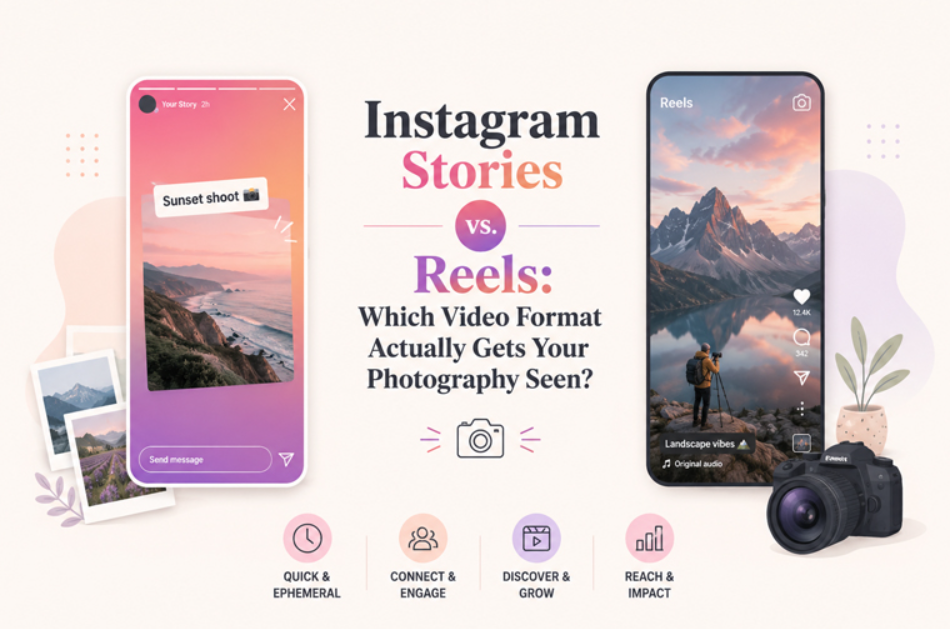
You spent three hours editing one landscape shot in Lightroom, posted it, and eleven people saw it. Sound familiar? The question of Instagram Stories vs. Reels: which video format actually gets your photography seen? isn’t academic for photographers anymore. Meta, Instagram’s parent company, has quietly rebuilt the platform around video, and the format you choose now matters as much as the image itself. The short answer: Reels get your work in front of strangers, Stories turn followers into clients. The longer answer, including the reach data and a workflow that doesn’t eat your shooting time, is below.
Do Instagram Reels Reach More People Than Stories?
Yes, and it’s not close. According to Socialinsider’s Instagram benchmarks, Reels reach an average of roughly 31% of your follower count, while Stories average around 12%. Reels also surface to people who don’t follow you at all, through the Explore page and the dedicated Reels tab. Stories almost never leave your existing audience.
That gap exists by design. Adam Mosseri, the head of Instagram at Meta, has said repeatedly that the platform pushes Reels as its discovery engine, largely in response to TikTok pulling younger users away. A Buffer study of four million posts backs this up: Reels earned more than twice the reach of single-image posts.
For a photographer with 800 followers, the math is blunt. A Story might get 100 views, all from people who already know your work. A Reel that catches the algorithm’s attention can put your portfolio in front of 5,000 strangers, some of whom shoot with the same gear, live in your city, or are planning a wedding. And the algorithm isn’t the only door in. Share-your-work spaces, like the self-promotion communities on Reddit, can put early Reels in front of people actively looking for accounts to follow, which hands the algorithm the initial engagement signal it needs.
Why the Algorithm Treats Photos and Video Differently
Instagram’s recommendation system rewards watch time, shares, and saves. A static photo gets a glance. A 15-second Reel that holds attention sends a much stronger signal, which is why even photographers who never wanted to be “video people” are turning stills into motion. The good news is you don’t need to film anything. A before-and-after edit recorded straight from Lightroom’s slider, a slow zoom across a print, or a sequence of five frames from one shoot all count as Reels. And once a clip is published, it keeps working for you: an Instagram Reels downloader like INDownloader lets you pull your own posted Reels back down for a portfolio site or client pitch deck without re-exporting the original project. Keep it to your own content, though; ripping other photographers’ Reels is a fast way to burn goodwill in a small industry.
One Practical Detail Most Guides Skip: the Crop
Both formats live in a 9:16 vertical frame, and this is where photographers get burned. A horizontal landscape shot dropped into a Reel loses two thirds of the frame, and the algorithm’s watch-time math doesn’t care how good the missing thirds were. Shoot a few frames on every job with vertical crops in mind, or compose loose enough to recrop later. Portrait, food, and real estate photographers adapt easily here; landscape shooters usually do better with slow pans across the full horizontal image than with static crops. Captions matter too, since Instagram now indexes them for search. “Golden hour elopement at Joffre Lakes” will outwork “magic light” every single time.
What Do Instagram Stories Do Better Than Reels?
Stories win at everything that happens after discovery: trust, conversation, and bookings. They sit at the top of your followers’ feeds, disappear after 24 hours, and support interactive stickers (polls, questions, countdowns, links) that Reels don’t. If Reels are your gallery opening, Stories are the conversation at the bar afterward.
Jared Polin of FroKnowsPhoto is a good working example. His Reels and YouTube clips pull in new viewers, but he uses Stories to answer gear questions and show the unglamorous middle of a shoot. That behind-the-scenes access is what converts a casual viewer into someone who buys a preset pack or books a session.
Stories also carry commercial weight that reach numbers hide. Marketers still put roughly a third of their Instagram budgets into Stories, because the link sticker drives traffic directly to booking pages and print shops. A wedding photographer I know gets nearly all her inquiries the same way: a Reel introduces her to engaged couples, but the DM that becomes a contract almost always starts from a Story question box. And unlike Reels, Stories can live on permanently as Highlights, which function as a free portfolio menu on your profile (“Weddings,” “Prints,” “BTS”).
This is the slow, compounding side of Instagram: consistent Stories, genuine replies to comments, and DMs answered like a human. If your goal is to build a loyal Instagram audience organically rather than chase one-off viral spikes that never convert, this is where that loyalty actually gets made.
The catch? A Story shown to 12% of an audience of 400 is 48 people. Stories can’t grow an account that nobody has found yet. That’s the job Reels do.
Instagram Stories vs. Reels: Which Video Format Actually Gets Your Photography Seen? The Real Verdict
If “seen” means seen by new people, Reels win outright. If “seen” means seen by the people most likely to hire you, buy a print, or refer a friend, Stories quietly outperform. Treat Reels as the top of your funnel and Stories as the middle, and the debate dissolves into a workflow question.
Here’s the part most comparison articles skip: photographers have an unfair advantage in this system. You already produce the raw material. Every shoot generates outtakes, editing timelapses, location B-roll from your phone, and client reactions. Other creators have to manufacture content; you just have to stop deleting yours.
A Repeatable Weekly Workflow for Photographers
One shoot can feed both formats for a week without extra filming:
- Two Reels: a 20 to 30 second before-and-after edit (screen-record Lightroom or export from CapCut, ByteDance’s free editor, with trending audio), plus a photo-sequence Reel of your five best frames.
- Daily Stories: the drive to the location, a poll asking which frame to print, the final image with a link sticker, and a question box.
- One repost cycle: when a Reel performs, share it to Stories with a “did you catch this?” sticker so your followers see it too.
Keep Reels short. Multiple studies point to around 30 seconds as the retention sweet spot, even though Instagram now allows Reels up to three minutes. Lead with your single strongest frame in the first second, because that first frame is your thumbnail and your hook at the same time.
One Warning Before You Go All-In on Reels
Photography is a community-driven niche, and communities compound faster than hashtags, so treat the workflow above as a floor, not a ceiling. But don’t let Reels reach seduce you into abandoning Stories. Accounts that go all-in on discovery often grow fast and monetize slowly, because they never built the follower relationship that Stories exist to serve. Reach without retention is just rented attention.
Conclusion
So, Instagram Stories vs. Reels: which video format actually gets your photography seen? Reels are the answer if your problem is invisibility, and for most photographers under 10,000 followers, it is. Stories are the answer once people arrive, because that’s where viewers become clients. The photographers growing fastest in 2026 aren’t choosing between them. They’re running a simple loop: Reels built from work they’ve already shot bring strangers in, Stories give those strangers a reason to stay, and Highlights hold the proof. Your next shoot already contains both. Post accordingly.