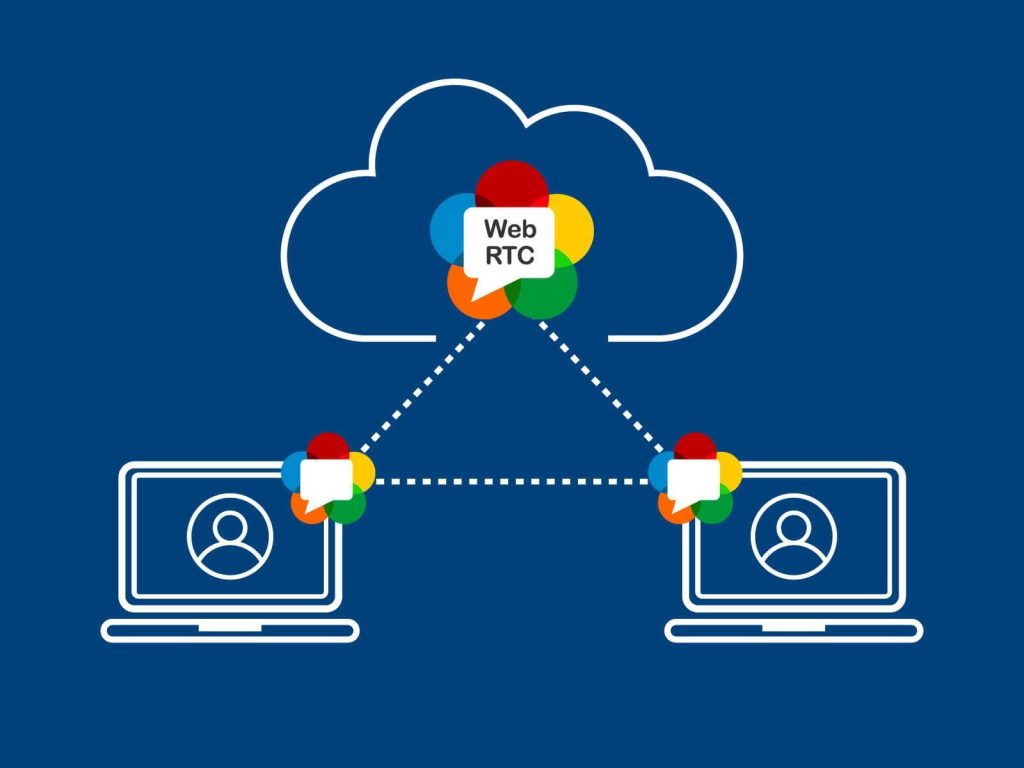
Real-time audio and video communication has become a standard feature in modern applications. Video interviews, online tutoring, telehealth, customer support calls, and team collaboration tools all depend on low-latency media exchange. WebRTC (Web Real-Time Communication) is the browser and mobile technology that makes this possible without requiring plugins. It enables peer-to-peer (P2P) media streaming and data transfer while handling encryption and network traversal behind the scenes. For developers learning advanced web capabilities in full stack developer classes, understanding WebRTC signaling and media stream flow is essential to building reliable calling experiences.
Core Pieces of a WebRTC System
A single API call is not what a WebRTC call consists of; it is rather a series of coordinated steps involving the browser, a signaling service, and in many cases relay infrastructure. Broadly speaking, WebRTC depends on:
- Media access: Use of the getUserMedia function to gain access to the camera and microphone.
- Establishing a peer connection: setting up an RTCPeerConnection in order to handle the negotiation of the network settings and the exchange of media.
- Signaling involves exchanging connection metadata (such as SDP offers and answers and ICE candidates) via an external channel.
- NAT traversal involves using STUN/TURN servers to discover a network path that is reachable.
- For secure transport, media is encrypted by default using DTLS and SRTP.
The main thing to note is that WebRTC specifies the way in which peers connect and pass on media, but it does not specify how signaling messages are delivered; this aspect is left to the developer.
Media Streams: Capturing and Sending Audio/Video
In WebRTC, media streams begin when the browser asks the user to grant access to their devices; the application then asks for audio, video, or both. If the user gives permission, the browser sends back a MediaStream which includes tracks, generally one audio track and one video track.
When you have the local stream, you add the stream’s tracks to the peer connection and WebRTC takes care of the encoding, packetisation, and transport. On the other end, the remote peer waits for the incoming tracks and displays them in a video or audio element.
Practical considerations:
- Always deal gracefully with situations where permission is denied.
- Enable the device to be switched (for example, between different microphones or cameras) in order to improve the user experience.
- Take care when using constraints (such as resolution and frame rate) to achieve a balance between quality and bandwidth.
- Provide the option to mute or unmute by switching the tracks on or off rather than by ending the call.
The students taking a full stack developer course in Bangalore usually go through these steps when putting together a simple one-to-one video calling demonstration, since it shows how browser APIs and networking work together.
What Signaling Does in WebRTC
Signaling refers to the process by which peers exchange information regarding the establishment of a connection. In the case of WebRTC peers, they need to share:
- Session Description Protocol (SDP) explains media features and how to negotiate settings.
- The network connectivity options were identified during the negotiations.
Since peers begin by being disconnected, they need a method of exchanging these messages. This is generally achieved by:
- WebSockets
- HTTP endpoints with polling
- Server-sent events
- Messaging queues (in some architectures)
The signalling server does not transmit audio or video; it only carries the metadata needed for the peers to set up the connection.
Offer/Answer Flow (SDP)
WebRTC commonly uses an offer/answer negotiation model:
- A peer connection is set up and an offer is generated by the caller.
- The offer is sent from the caller to the callee through the signalling channel.
- Calle sets the offer as the remote description, draws up a response, and sends it back.
- The caller enters the remote description as the answer.
As a result of the exchange, both peers will know which codecs, media tracks, and transport methods are to be used.
ICE Candidate Exchange
Candidates for ICE (Interactive Connectivity Establishment) are potential network routes. When the connection is being set up, each peer collects the candidates and passes them to the other party via signalling. As each candidate is received, it is included in the peer’s connection. This process goes on until a functional path has been discovered.
It is in this case that real-world complexity is encountered; users are usually located behind NATs, firewalls, or in restrictive networks, which means that WebRTC requires extra infrastructure in order to achieve a reliable connection.
STUN and TURN: Making P2P Work on Real Networks
Ideally, the peers connect directly, but in actuality a number of devices are located behind routers which prevent inbound connections. To solve this, WebRTC makes use of STUN and TURN servers.
STUN (Session Traversal Utilities for NAT)
A STUN server enables a device to find out its public IP address and port number so that other peers can make a direct connection even when there is a NAT. The STUN protocol is simple and does not involve relaying of the media.
TURN (Traversal Using Relays around NAT)
When a direct connection does not work, the TURN servers will relay the media between the two peers. TURN is important for ensuring reliability, in particular in enterprise networks or in the case of symmetric NATs. The disadvantage is increased cost and latency since the media has to go through the relay.
A practical deployment usually includes:
- STUN for direct connection attempts
- TURN for fallback when direct routes fail
Understanding this infrastructure enables developers to design systems which work consistently, not only in test environments but also in production-like ones. It is a typical lesson taught in full stack developer courses when developers move from local demonstrations to production-like setups.
Handling Call Quality, Bandwidth, and User Experience
The work is not finished once the connection has been established. The quality of media transmitted in real time relies on the network conditions and on the performance of the device. WebRTC provides tools such as:
- Adaptive bitrate and congestion control
- Statistics APIs for monitoring packet loss, jitter, and round-trip time
- Track replacement (switching camera) without reconnecting
- Simulcast and scalable video coding in more advanced scenarios
Good applications also plan for:
- Reconnect logic when network changes (Wi-Fi to mobile data)
- Graceful handling of device loss (mic unplugged)
- Clear UI indicators for connection state and mute status
- Echo cancellation and noise suppression settings where appropriate
Conclusion
WebRTC achieves peer-to-peer audio and video communication by integrating media capture, the negotiation of peer connections, and secure transport. The signaling function is the coordination layer which swaps out offers, answers, and ICE candidates so that the peers can locate a working network path. STUN and TURN services help with NAT traversal and ensure reliability in cases where direct connectivity is not possible. When developers understand these fundamental components, they will be able to design real-time communication features that function well regardless of the network or device. For those who are studying full stack developer classes or taking a full stack developer course in Bangalore, WebRTC serves as a practical illustration of how front-end APIs, backend signaling, and the networking infrastructure work together to deliver real-time user experiences.
For more details visit us:
Name: ExcelR – Full Stack Developer Course in Hyderabad
Address: 49, 2, Unispace Building, 4th-floor, Plot No.47 48, Street No. 1, Patrika Nagar, Madhapur, Hyderabad, Telangana 500081
Phone: 08792483183
Email: [email protected]